Two master’s students from Norway, Nils Oskar Tronrud and Sebastian Kronback, visited Bojonegoro. The arrival of the two students is to understand the dynamics of oil and gas natural resources, as well as the socio-economic, environmental, and political aspects in the area often referred to as Kota Ledre.
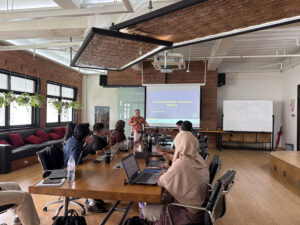
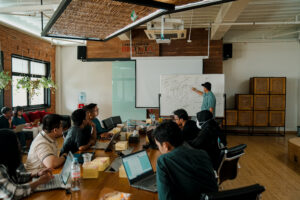
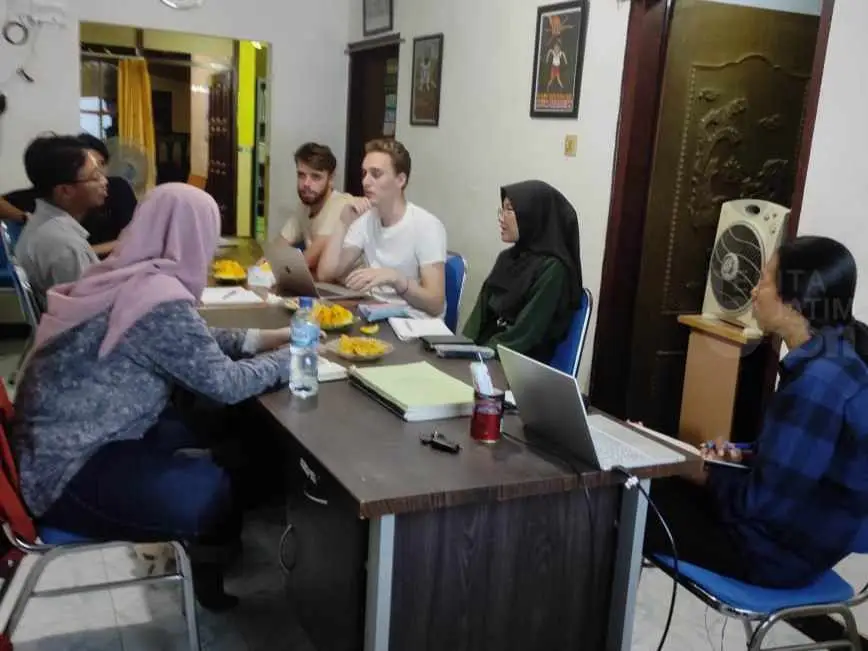
Nils and Sebastian, their familiar names, accompanied by a team from the Research Center for Politics and Government (Polgov) at Gadjah Mada University (UGM), visited the Collaboration House, where they met with representatives from the Bojonegoro Institute and the Independent Journalists Alliance (AJI) of Bojonegoro, on Thursday (15/9/2022) evening.
Kiki Nurshafira, a representative from Polgov UGM, stated that the purpose of their visit is to learn about the dynamics of Bojonegoro as the largest oil and gas-producing regency in Indonesia.
“Our purpose in coming here is to meet with our friends from the Bojonegoro Institute and AJI, to learn a lot about the dynamics of oil and gas in Bojonegoro, especially those related to the social dynamics and policy governance of oil and gas in the region,” said Kiki, her familiar nickname.
In response, Aw Syaiful Huda, the Director of the Bojonegoro Institute, warmly welcomed the visit, expressing a keen interest in learning, especially from Nils and Sebastian, about the Eternal Oil Fund in Norway. “While we have the opportunity to meet with Nils and Sebastian, we can learn about the Eternal Oil Fund established by the Norwegian Government,” he said.
According to Nils, the establishment of the Eternal Oil Fund in Norway was inspired by learning from the Netherlands, which was once rich in oil and gas but became poor again after their oil resources were depleted. The Netherlands even experienced the Dutch Disease, where despite abundant natural resources, it led to a drastic economic decline.
Discussions about social dynamics – including the role of the Bojonegoro Institute and AJI Bojonegoro in overseeing the oil and gas industrialization in the region to avoid the resource curse – were conducted quite warmly. Although the discussion was relaxed, the questions and responses were serious, requiring the presentation of data and supporting materials several times.
Then, when it was Nils and Sebastian’s turn to present about the Eternal Oil Fund established by the Norwegian government in 1990, Nils opened his laptop and displayed a website showing data and information about Norway’s Eternal Oil Fund, also known as “the Government Pension Fund Global.”
According to Nils’s explanation, information about the eternal oil fund, or “the Government Pension Fund Global,” is very open and accessible to the public online and in real-time. Nils then showed the website page in question, which was viewed by everyone present. The website page displayed the real-time value of the eternal oil fund, including analytical data and annual audit report documents.
Nils also mentioned that only about 3.5 percent of the investment value of Norway’s eternal oil fund is withdrawn or included in Norway’s annual national budget for development expenditure. Assets from “Norway’s oil fund” are also used for investments in renewable energy sectors. For your information, the Collaborative House is a coworking space initiated by the Bojonegoro Institute and AJI Bojonegoro, functioning as a workspace for working, creating, and building collaboration among civil society activists and journalists in the region.