
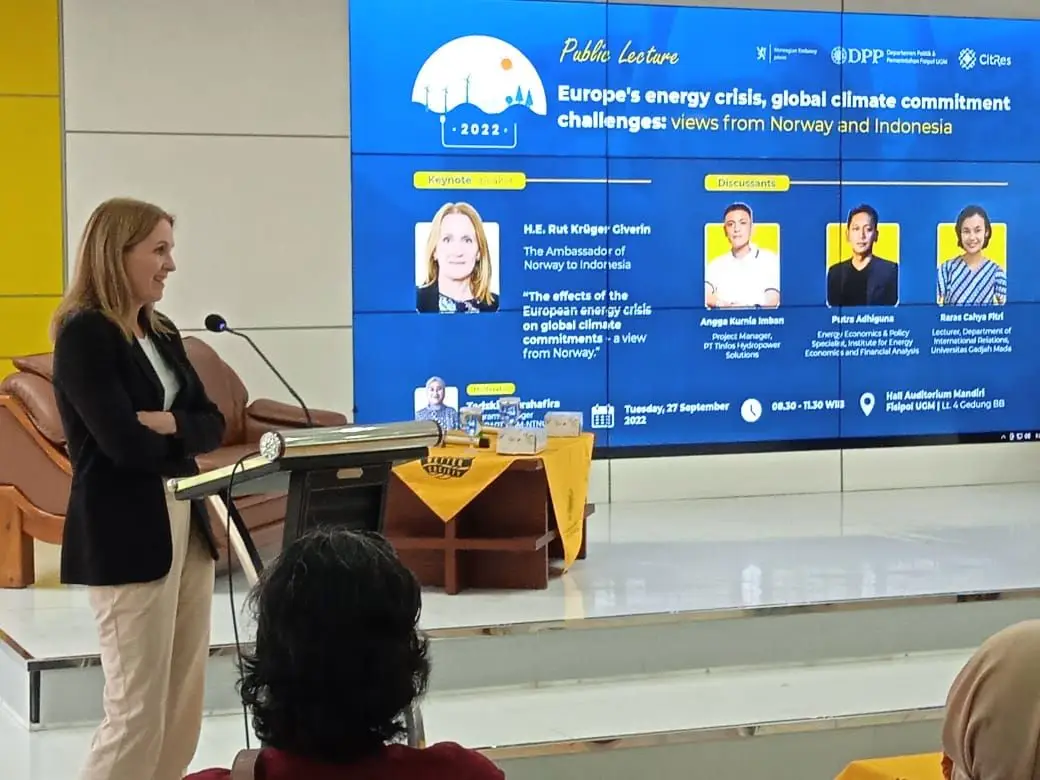
Norwegian Ambassador to Indonesia, Rut Kruger Giverin, revealed the strong support her country has provided for Indonesia to preserve its forests. Over the past decade, the Oslo Government has allocated approximately US$100 million or around Rp 1.5 trillion for programs with that objective.
“If you followed the news last week, you might have seen that Indonesia and Norway have agreed to initiate a new partnership in the field of forestry,” Rut said during a public lecture at the Faculty of Social and Political Sciences, Gadjah Mada University (UGM), on Tuesday, September 27, 2022.
She reiterated Norway’s role as a strong supporter of Indonesia’s efforts to preserve its rainforests, peatlands, and mangroves. She mentioned that Indonesia’s rainforest is the third-largest in the world. Indonesia also, according to Rut, has some of the largest peatland and mangrove areas globally.
“Forests, peatlands, and mangroves store a significant amount of carbon. This is crucial not only for Indonesia but also for the global climate and biodiversity,” Rut said during her public lecture titled “Europe Energy Crisis, Global Climate Commitment Challenge.”
She added that simultaneously, historically, land-use changes, including deforestation and forest fires, have contributed to most of the greenhouse gas emissions in Indonesia. Therefore, she praised the achievements claimed by the government in Jakarta through the lowest deforestation rates in the last 20 years.
That’s considered a success worldwide,” she said, adding, “Now you are a global leader in reducing deforestation.”
Barriers to Renewable Energy Investment in Indonesia
It’s not just the forestry sector, Rut also reminded that Norway and Indonesia are also collaborating in the maritime sector. She emphasized the crucial role of the oceans in absorbing CO2 and stabilizing the climate, and both governments are members of the High-Level Panel for Sustainable Ocean Economy.
Norway, Rut said, supports several initiatives in Indonesia aimed at rehabilitating mangroves and preventing marine litter. She also assessed the potential for cooperation in offshore renewable energy development as significant, with Norwegian companies actively exploring opportunities in the Indonesian market.
In the energy sector, Norway has allocated 10 billion Norwegian kroner for climate funds in developing countries. According to Rut, the fund managers, along with several Norwegian private companies, are eager to invest in renewable energy in Indonesia.
Unfortunately, she added, the current energy regulatory framework in Indonesia does not support renewable energy. “So it’s very challenging for foreign investors to identify commercially viable renewable energy projects in Indonesia,” Rut said.
Energy Crisis in Europe Due to the Russia-Ukraine War
On the other hand, Rut also revealed the impact of the Russia-Ukraine war on the energy situation in Europe and in her own country. She mentioned that Norway is the largest oil and gas producer in Western Europe. Before the war, the country contributed nearly a quarter of Europe’s gas imports and around a tenth of crude oil imports.
As Europe seeks to become independent from energy imports from Russia, Norway will remain a stable and measured supplier of oil and gas to Europe. Norway is part of the integrated electricity market in Northern Europe, with cables connecting to the UK, the Nordic countries, and Northern Germany.
“In our integrated electricity market – Nordpool – electricity flows to places with the highest prices, meaning high prices in our neighboring countries translate into higher prices in Norway,” Rut said.
Another issue is that 98 percent of Norway’s domestic energy production comes from renewable sources, mostly hydropower. However, an exceptionally dry spring has left many reservoirs in southern Norway historically low for much of this year.
To preserve and build up reservoirs during the winter months, the Norwegian government has decided to curb electricity exports. This is done until the reservoir water levels are sufficiently high to secure electricity supply for the coming winter.
The war in Ukraine has also caused European and global energy prices to soar, leading to short-term negative effects on consumers and the broader economy. But one positive outcome is that the rise in energy prices, Rut said, is further driving and accelerating the development and deployment of large amounts of cheap renewable energy globally. “There is already a lot of evidence from governments and companies developing policy frameworks and advancing investments in renewable energy,” she said.