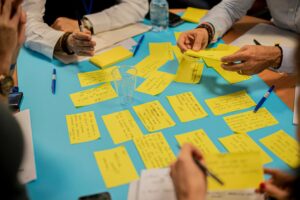

Through the SUSTAIN Program, Universitas Nusa Cendana (UNDANA) and Universitas Gadjah Mada (UGM) organized curriculum improvement workshops emphasizing the principles of citizen participation, sustainable transition, and gender equality. The curriculum workshops at UNDANA were conducted for undergraduate programs, while those at UGM targeted master’s programs.
As part of the curriculum development initiative, the project supported UNDANA in offering a series of courses on Women and Politics, which specifically address issues of gender and development. These courses also integrate gender-related issues into electoral studies, including representative institutions, political parties and elections, as well as anti-corruption education. The courses expand discussions of political concepts by incorporating gender-sensitive perspectives in areas such as resource governance and clientelistic politics.
The project also contributed to enriching the research roadmap of the Political Science Program at UNDANA in collaboration with the Directorate General of Higher Education, with a focus on gender and natural resources. This was achieved through research conducted in 2022 on salt resource governance in Malaka Regency, East Nusa Tenggara Province, and a study on women’s participation in the East Nusa Tenggara Provincial Parliament.
At UGM, the project played a key role in a series of curriculum workshops aimed at incorporating new materials on multiculturalism and gender sensitivity into the Master’s Program in Politics. In addition, the project supported the development of an anti-sexual violence mentoring program, which was integrated into the faculty-level student admission process. Following the completion of the workshops, curriculum revisions were successfully implemented at UGM through a combination of surveys, public lectures, and conventional classroom activities.
The project also contributed to methodology courses in both undergraduate and master’s Political Science programs by conducting a survey on ‘Youth and Climate Change.’ The survey was carried out in September 2022 and collected data from 1,020 respondents aged 20–28 across various cities in Java, Sumatra, Kalimantan, Sulawesi, Bali, and Nusa Tenggara.