The abundance of oil and gas resources in Bojonegoro, East Java, along with the social, economic, environmental, and political dynamics in the area, often referred to as “Kota Ledre,” has attracted the attention of many parties. This includes foreigners like Nils Oskar Tronrud and Sebastian Kronback, master’s students from Norway.
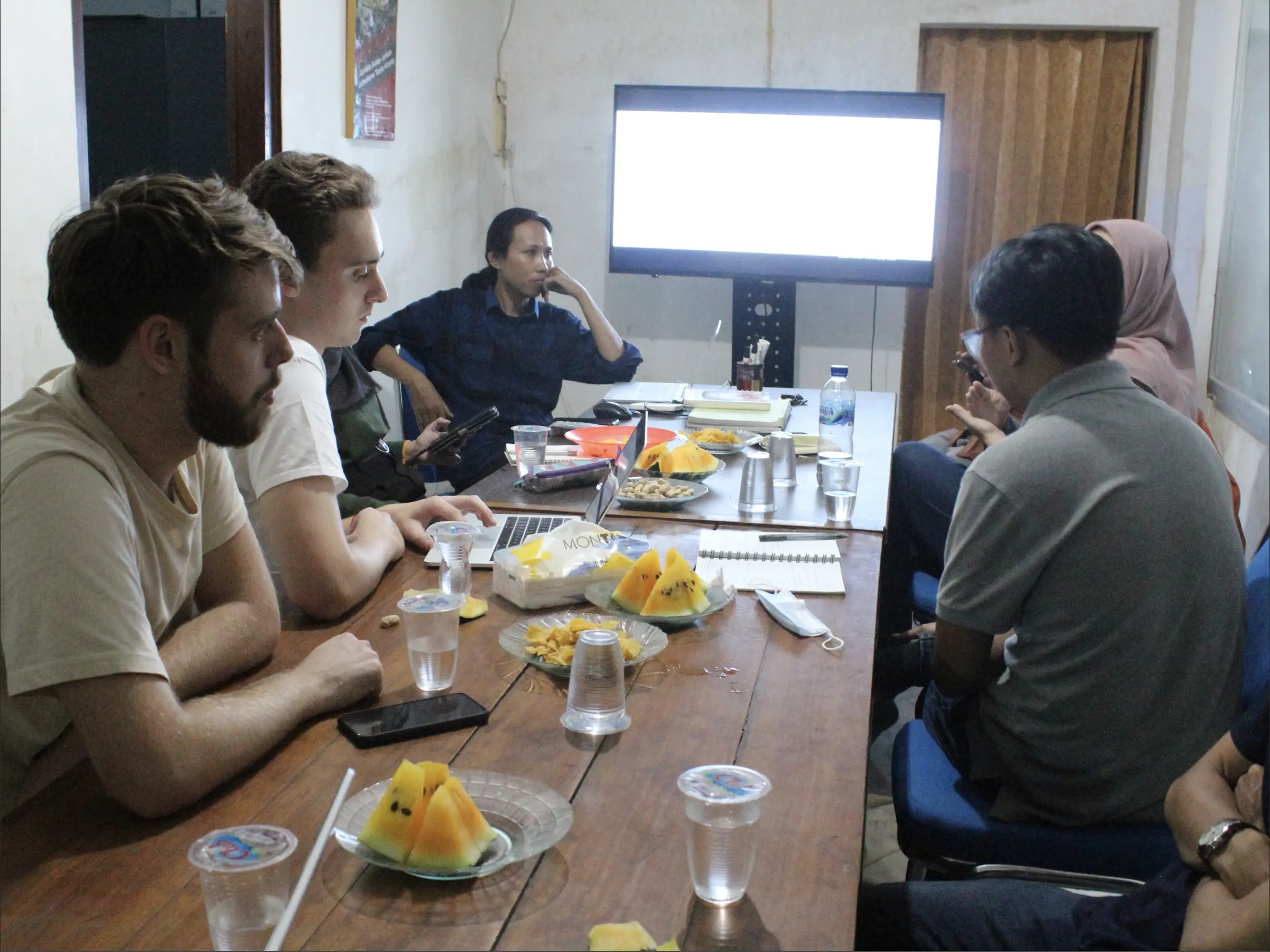
Nils and Sebastian, both well-known by their first names, accompanied by a team from the Research Center for Politics and Government (Polgov) at Gadjah Mada University (UGM), visited the Collaborative House to meet with representatives from the Bojonegoro Institute and the Independent Journalist Alliance (AJI) Bojonegoro on Thursday (15/9/2022).
Kiki Nurshafira, a representative from Polgov UGM, stated that the purpose and objective of their visit were to learn about the dynamics of Bojonegoro as the largest oil-producing district in Indonesia.
“Our purpose in coming here is to meet with friends from the Bojonegoro Institute and AJI to learn a lot about the dynamics of oil and gas in Bojonegoro, especially regarding the social dynamics and policy governance of oil and gas in the region,” Kiki, as she’s commonly called, expressed.
Responding to this, Aw Syaiful Huda, the Director of the Bojonegoro Institute, warmly welcomed the visit. He even expressed an interest in learning, especially from Nils and Sebastian, about Norway’s Eternal Oil Fund.
“Since we met Nils and Sebastian, who came all the way from Norway, we wanted to inquire about the description of the Eternal Oil Fund established by the Norwegian Government, which, according to many sources, is considered one of the best forms of Eternal Oil Funds in the world in terms of accountability and governance,” Awe said.
After the introduction session, the discussion started with a joint viewing of a documentary film collaboration between Pattiro, the Bojonegoro Institute, and the Research and Application Discourse Institute (LPAW) Blora, titled “People, Oil, Policy; Playing Between Welfare and Curse.”
After the film screening, a discussion about social dynamics, including the role of the Bojonegoro Institute and AJI Bojonegoro in overseeing the industrialization of oil and gas in the area to avoid the curse of natural resources, ensued and became quite lively.
Although the discussion was casual, the questions and responses raised were quite serious, requiring the presentation of data and supporting materials several times.
Then, when it was Nils and Sebastian’s turn to present about the Eternal Oil Fund established by the Norwegian government in 1990, Nils opened his laptop and displayed a website containing data and information about Norway’s Eternal Oil Fund, also known as “the Government Pension Fund Global” or “Norway’s oil fund.”
According to Nils’ explanation, information about the Eternal Oil Fund, also known as “the Government Pension Fund Global,” is very open and can be accessed by the public online and in real-time. Nils then showed the website page to everyone present. On the website page, the value of the Eternal Oil Fund was visible in real-time, including analysis data and annual audit reports.
Nils also mentioned that only about 3.5% of Norway’s Eternal Oil Fund investment value is withdrawn or included in Norway’s annual state budget for development expenses. Assets from “Norway’s oil fund” are also used, including investments in the renewable energy sector.
As it was already late at night, the discussion, which started at 8:00 PM local time, was finally concluded by 11:00 PM local time. As additional information, the Collaborative House is a coworking space initiated by the Bojonegoro Institute and AJI Bojonegoro. Its function is as a workspace, fostering creativity, and building collaborations among civil society activists and journalists in the region.