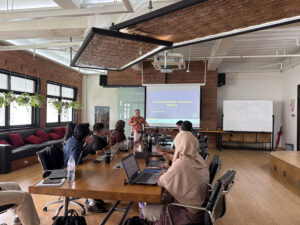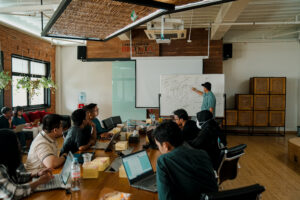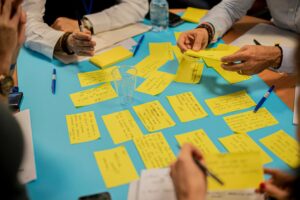
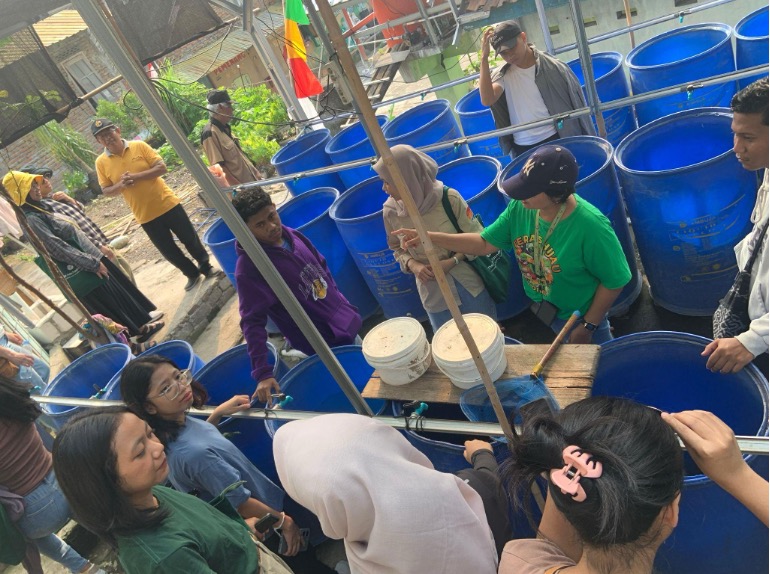
The SUSTAIN Project facilitated a student mobility program at the Research Center for Politics and Government (PolGov), Universitas Gadjah Mada, as part of its commitment to expanding opportunities for collaboration and knowledge exchange among diverse stakeholders. Held on 25 August 2025, the activity involved the Kali Code Community as a local partner actively engaged in community-based environmental management initiatives.
The program brought together participants from SUSTAIN partner institutions, including the Norwegian University of Science and Technology (NTNU), Universitas Gadjah Mada (UGM), and Universitas Nusa Cendana (UNC). Through a field visit and dialogue sessions with residents, participants had the opportunity to learn directly from a community that has long been involved in environmental stewardship and river management along the Code River.
The activity served as a platform for knowledge exchange between local community members, students, researchers, and academic staff. Community representatives shared practical experiences related to river clean-up initiatives, waste management practices in riverbank areas, and the use of simple, low-cost technologies to meet daily water needs. At the same time, students, researchers, and lecturers contributed analytical perspectives from the fields of environmental governance, urban studies, and public policy.
The interaction encouraged broader discussions on urban water governance from different institutional, disciplinary, and regional perspectives. These exchanges not only enriched participants’ learning experiences but also provided valuable insights into the challenges and opportunities of promoting more inclusive and sustainable environmental management. Through its collaboration with the Kali Code Community, the SUSTAIN Project demonstrates the importance of linking academic learning with community-based practices. The activity further strengthened partnerships between universities and local communities, ensuring that knowledge generated through the project contributes not only to education and research but also to addressing real-world challenges and supporting grassroots initiatives.