The global transition towards clean energy is increasing demand for strategic minerals that are essential to emerging energy technologies. Nickel, alongside cobalt, lithium, copper, graphite, and rare earth elements, has become an important component of global renewable energy and electrification supply chains. This growing demand has contributed to the expansion of mineral extraction and processing activities in various parts of the world, including Indonesia.
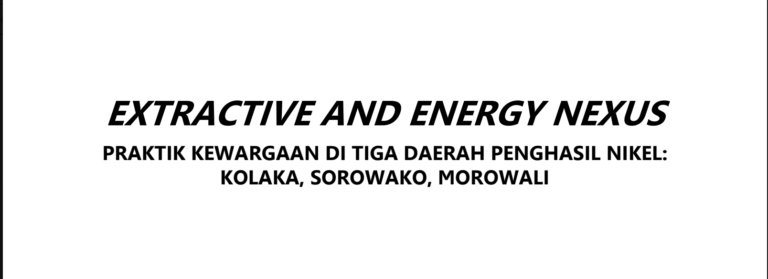
Against this backdrop, the “Energy-Extractive Nexus” research explores how the energy transition and the expansion of extractive industries intersect, particularly in reshaping relationships between the state and communities in resource-rich areas. The research examines how identities, narratives, symbols, and practices are mobilised to gain local access to and control over natural resources, as well as how affected communities contest, negotiate, and participate in shaping policies and practices within extractive industries connected to global production networks.
To understand these dynamics, the research was conducted in three nickel-producing regions in Sulawesi: Kolaka in Southeast Sulawesi, Sorowako in East Luwu, South Sulawesi, and Morowali in Central Sulawesi. The research also traced decision-making processes in Jakarta to examine how national-level policies and decisions are connected to developments in nickel-producing regions.
These three locations represent different stages and characteristics of Indonesia’s nickel industry. Kolaka represents nickel mining and ferronickel processing activities. Sorowako represents nickel mining and nickel matte processing, which have been ongoing since the late 1960s. Meanwhile, Morowali illustrates the large-scale development of nickel processing and refining through the Indonesia Morowali Industrial Park (IMIP), which is also connected to the supply of materials for the steel and battery industries.
By tracing decision-making processes from the national level to resource-producing regions, the research demonstrates that challenges faced by communities in mining areas cannot be separated from broader economic and political dynamics. Downstream industrial policies, global market demand, investment flows, and responsible mining standards all shape the opportunities available for communities to access benefits while responding to the impacts of the nickel industry in their regions.
The findings highlight the importance of understanding state–citizen relations beyond what takes place at the local level. Global policies and initiatives. including Environmental, Social and Governance (ESG) practices, transparency initiatives such as the Extractive Industries Transparency Initiative (EITI), and responsible mining standards such as the Initiative for Responsible Mining Assurance (IRMA), also influence how companies, governments, and communities interact in resource-rich areas. Citizen engagement therefore takes place within a multi-scalar space, where local demands intersect with national interests and global economic dynamics. The research demonstrates that communities’ ability to access benefits, anticipate impacts, and influence resource governance is shaped by their position within these broader networks of relationships.